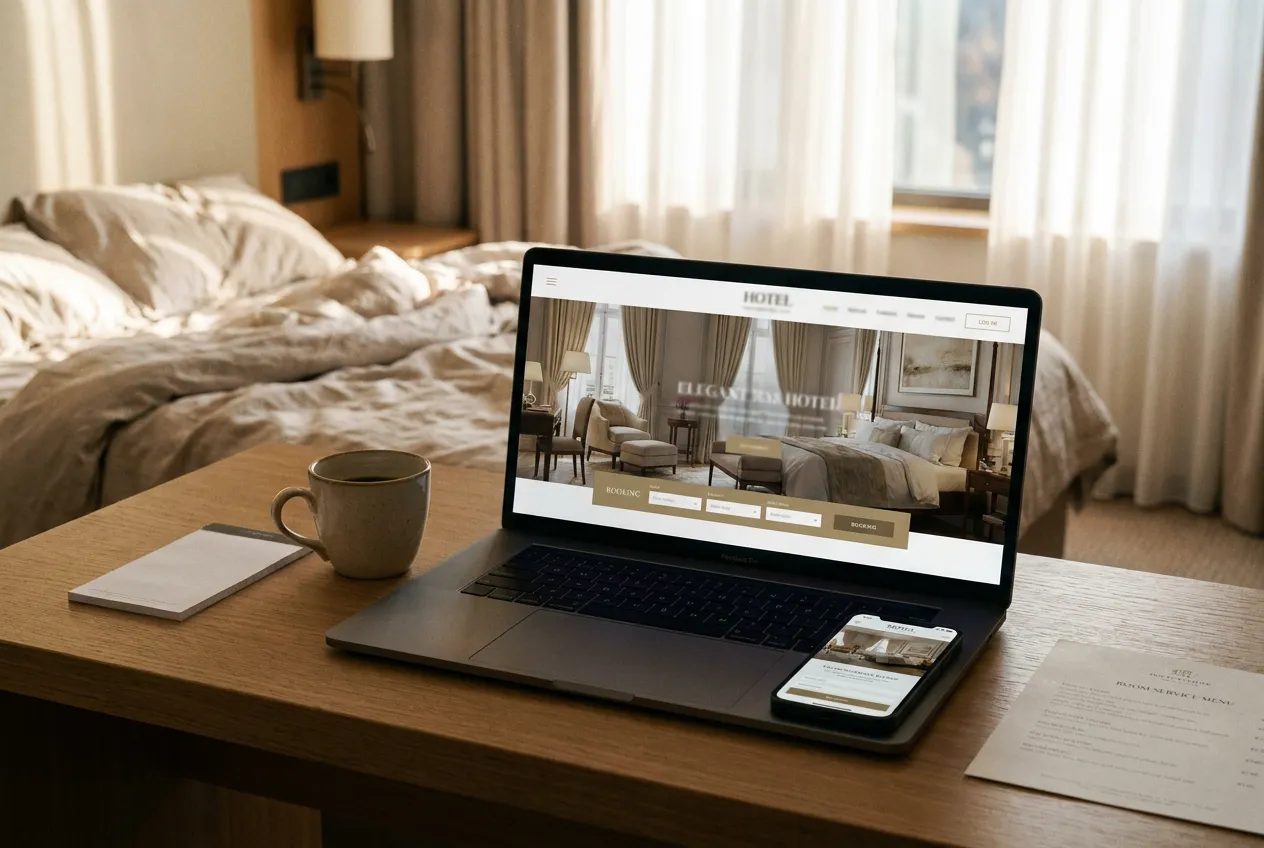
A hotel website has one job beyond looking good: helping a guest feel confident enough to book. The best hotel website design combines beautiful photography with speed, clarity and a booking path that never gets in the way.
Use this checklist of twelve features to audit your current site or brief a designer. Each item connects to a real guest need, and none of them requires a complicated rebuild.
The Foundation: Speed, Mobile and Structure
1. Fast loading, mobile first design
Guests browse on phones in short sessions. Compress images, limit heavy scripts and design the small screen first. A slow page loses guests before they see a single room.
2. A visible booking bar
Keep dates, guests and a "Book Now" control accessible on every page, including a sticky version on mobile. A guest who decides at any point should be one tap from availability.
3. Clear, simple navigation
Limit the main menu to what guests need: rooms, dining, experiences, location, offers and contact. Descriptive labels help both guests and search engines.
Showing the Property Well
4. High quality, authentic photography
Show real rooms, real views and real people enjoying them where appropriate. Include the bathroom, the outdoor spaces and the neighborhood. Add descriptive alt text to each image for accessibility and search.
5. Dedicated room and suite pages
Each room type deserves its own page with original description, bed configuration, size, amenities, a gallery and a booking link. Avoid copying the descriptions supplied by your booking engine or OTAs.
6. Video and virtual tours
A short walkthrough helps guests understand layout and atmosphere. Keep video light so it does not slow the page.
Building Trust and Removing Doubt
7. Transparent rates, taxes and policies
Surprise fees are a leading reason guests abandon bookings. Explain what is included, how taxes and resort fees apply, and what cancellation terms are before the payment step.
8. Reviews and trust signals
Feature recent guest comments, awards you can verify and secure payment indicators. Place them near booking buttons, where doubt appears.
9. A clear direct-booking benefit
Tell guests why booking direct is better: perks, flexibility or member rates. State it plainly in the booking bar area and repeat it in confirmation emails. See how this reduces dependence on OTAs in our guide to lowering Expedia and Booking.com commission costs.
Not sure where your hotel stands?
Get Your Free Hotel Marketing Audit
We review your search visibility, website conversion, OTA dependence and reviews, then send a personalized report with next steps.
Get Your Free Hotel Marketing AuditMaking the Site Findable and Useful
10. Search friendly structure
Unique title tags and meta descriptions, one H1 per page, clean URLs, a sitemap and schema markup help search engines understand your hotel. Our hotel SEO services cover these basics, and our guide to getting your hotel found on Google explains the process.
11. Location, map and local content
Show exactly where you are, how to arrive and what is nearby. Local guides and event pages turn your site into a destination resource, not just a brochure.
12. Accessibility and easy contact
Use readable contrast, keyboard friendly navigation, descriptive alt text and clear form labels. Offer easy ways to ask a question by phone, email, chat or message, and respond quickly.
A Quick Self Audit
Open your site on your phone and try to book a room for next month. Count the taps, note anything slow or confusing, and ask someone unfamiliar with your hotel to do the same. Those observations are more valuable than any design trend.
Our AI-powered websites are built around these twelve features, and our free hotel marketing audit reviews how your current site performs.
Frequently Asked Questions
What makes a good hotel website?
A good hotel website loads quickly on mobile, shows authentic photography, makes the booking path simple, explains rates and policies clearly, builds trust with reviews and is structured so search engines can understand it.
How often should a hotel redesign its website?
There is no fixed schedule. Many hotels refresh content and photos regularly and rebuild when the site is slow, outdated, hard to use on mobile or no longer reflects the property.
Should the booking engine be on my own domain?
A booking engine that looks and feels like your site reduces drop-off. Check that it is mobile friendly, branded and does not confuse guests when they move from your pages to checkout.
How many photos should a hotel room page have?
Enough to show the room, bathroom, view and key amenities honestly. Quality and relevance matter more than a specific number, and each image should be optimized for speed.
Ready for a clear plan?
Get Your Free Hotel Marketing Audit
We review your search visibility, website conversion, OTA dependence and reviews, then send a personalized report with next steps.
Get Your Free Hotel Marketing AuditKeep Learning
Want to see how your property ranks against local competitors?
Request your free hotel audit. We review your search visibility, website conversion, OTA dependence and reviews, and send a personalized report within 24 business hours.
Ready to Put These Strategies to Work?
Let's build a custom digital marketing strategy tailored to your property and goals.